
Martha Underwood Built Prismm to Keep Family Wealth From Walking Out of the Bank
By Pharoh Martin·
3 min read
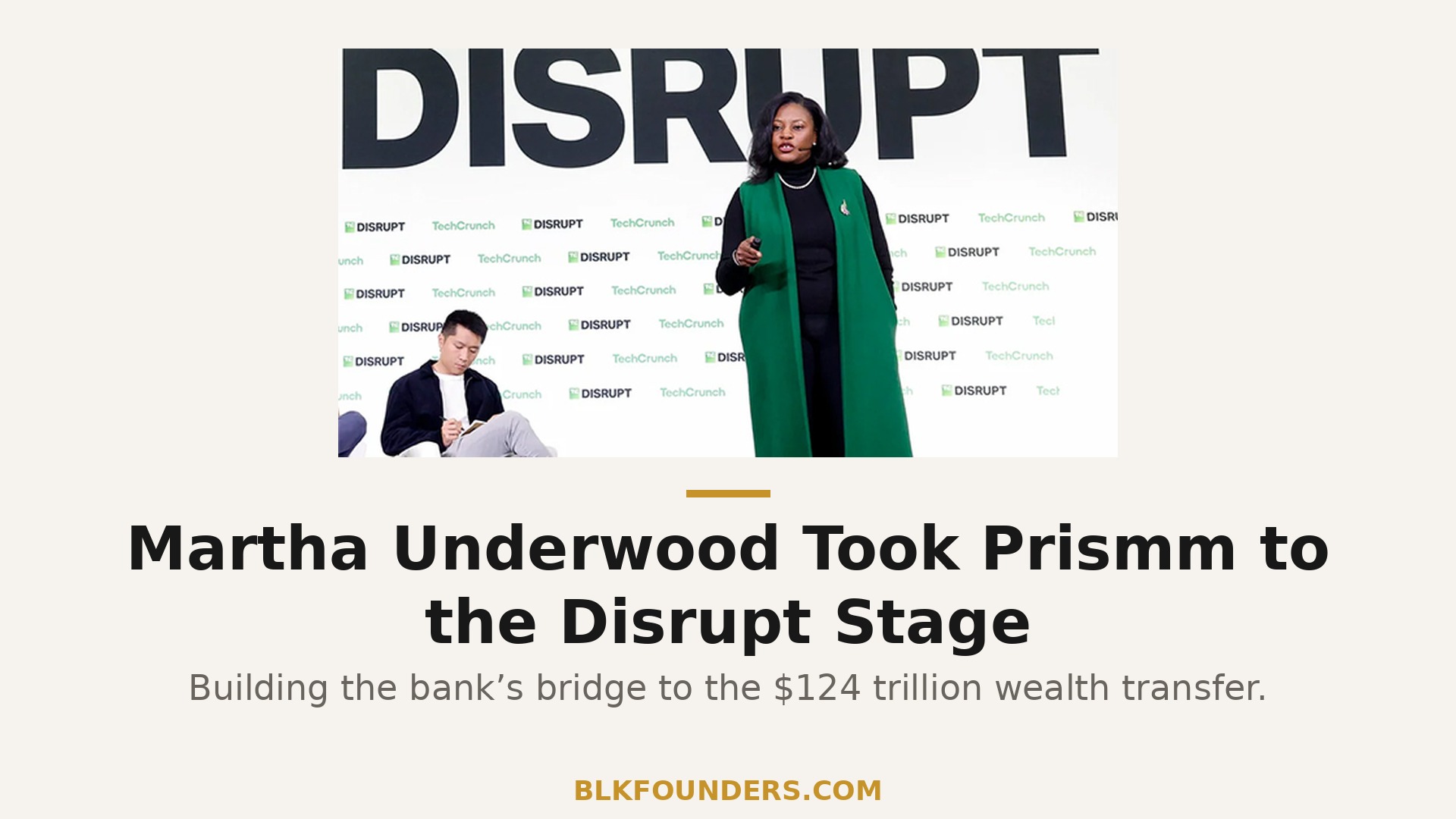
On October 14, Martha Underwood stood on the TechCrunch Disrupt stage in San Francisco and pitched the room a problem most banks do not know they have: when their customers die, the money leaves, because the bank never met the heirs.
Underwood is the founder and CEO of Prismm, a Birmingham-area fintech company building what it calls inheritance infrastructure for banks and credit unions. Prismm was one of 20 finalists in Startup Battlefield, selected from the Startup Battlefield 200 out of thousands of applications. Each finalist got six minutes to pitch and demo in front of venture investors. Underwood presented in the Enterprise and Security semifinal session.
It started with a fall
Underwood came to the problem twice, and the first time was personal. During Hurricane Irma, her father fell off a roof and was rushed to the hospital. Her mother was left scrambling for the documents a crisis demands: health directives, insurance details, account information. The family got through it, but the gap stayed with her.
"Love for my parents inspired this, and I never want anyone else to feel that helpless in an emergency," Underwood told Innovation Depot, the Birmingham startup hub where she and her sister and co-founder, Shella Sylla, built the company.
The second encounter was professional. Across a 25-year career in enterprise technology and global banking, with roles at IBM and PNC, Underwood watched the same gap operate at scale. Institutions held the accounts but rarely knew the people who would inherit them. When an account holder died, the relationship, and usually the deposits, left with the money.
What Prismm sells
Prismm is a digital vault and estate orchestration platform that financial institutions offer their customers. Account holders organize beneficiaries, documents, and critical information while they are alive and engaged, so when a death happens, the institution already knows the heirs and can help the family complete eligible transfers instead of starting from zero in a probate line.
The company also built a measuring stick for the risk. Its Deposit Mortality Index scores all 8,365 federally insured U.S. banks and credit unions on their exposure to deposits leaving as account holders die, using public data from the FDIC, the Census Bureau, the Federal Reserve, and the Social Security Administration. The October edition estimates $1.46 trillion in deposits could leave U.S. institutions over the next 10 years, finds nearly two-thirds of banks scoring Elevated or higher, and shows the exposure is heaviest at community institutions, the banks and credit unions that serve the neighborhoods the large banks left.
Why the stakes are not evenly shared
The backdrop is the largest wealth transfer in U.S. history. Cerulli Associates projects $124 trillion in U.S. wealth will change hands through 2048, with $105 trillion going to heirs.
But an inheritance only builds wealth if it arrives. The Federal Reserve's 2022 Survey of Consumer Finances put median Black family wealth at $44,900, against $285,000 for white families. When a family's main asset is a house or a single account, losing track of it at death is not an inconvenience. It can erase the inheritance entirely.
Underwood made that case from the Disrupt stage: "Black families lose more than money when an account holder dies without the institution knowing the heirs. They lose the relationship, the history, and sometimes the house. I built Prismm so the bank is in the room when that transfer happens, and I took it to Disrupt so the people who fund the future of banking would hear it from me."
Where Prismm stands
Prismm is live in the market, with several credit unions lined up to onboard and a Mississippi bank identified as a customer in reporting last year. The company joined the Jack Henry Fintech Integration Network in May 2026, a distribution channel into thousands of community banks and credit unions, and says it is in conversations with institutions nationwide.
Underwood was named to Parity's Top 100 Women in Tech 2026 and is the author of The Death of Deposits, a book-length version of the argument she took to Disrupt.
Five Battlefield finalists advanced to the October 15 final, where Intero Biosystems won the $100,000 equity-free prize. Prismm did not take the trophy home. It took something arguably more useful for an infrastructure company selling to cautious banks: a national stage, a room full of the investors who fund banking's future, and proof that the heir problem is now a category with a name. She named it.
Related Coverage
 Startups
Kofi Asante Is the First Black Founder of a Nuclear Energy Company in the U.S., and He Has Raised $60M to Put Reactors on Barges
By Pharoh Martin·
 Startups
Sensori Raised Nearly $1M Without a Single VC Check
By Pharoh Martin·
 Startups
SpaceX Is Buying David Grain's Spectrum Portfolio in a Reported $8 Billion Deal
By Pharoh Martin·
The Newsletter
The week in Black entrepreneurship, in one email.
News, data, and playbooks. Free, weekly, no noise.